
Origami Tech on HackerNoon: Hyperliquid's Evolution Beyond Crypto Perpetuals
Introduction
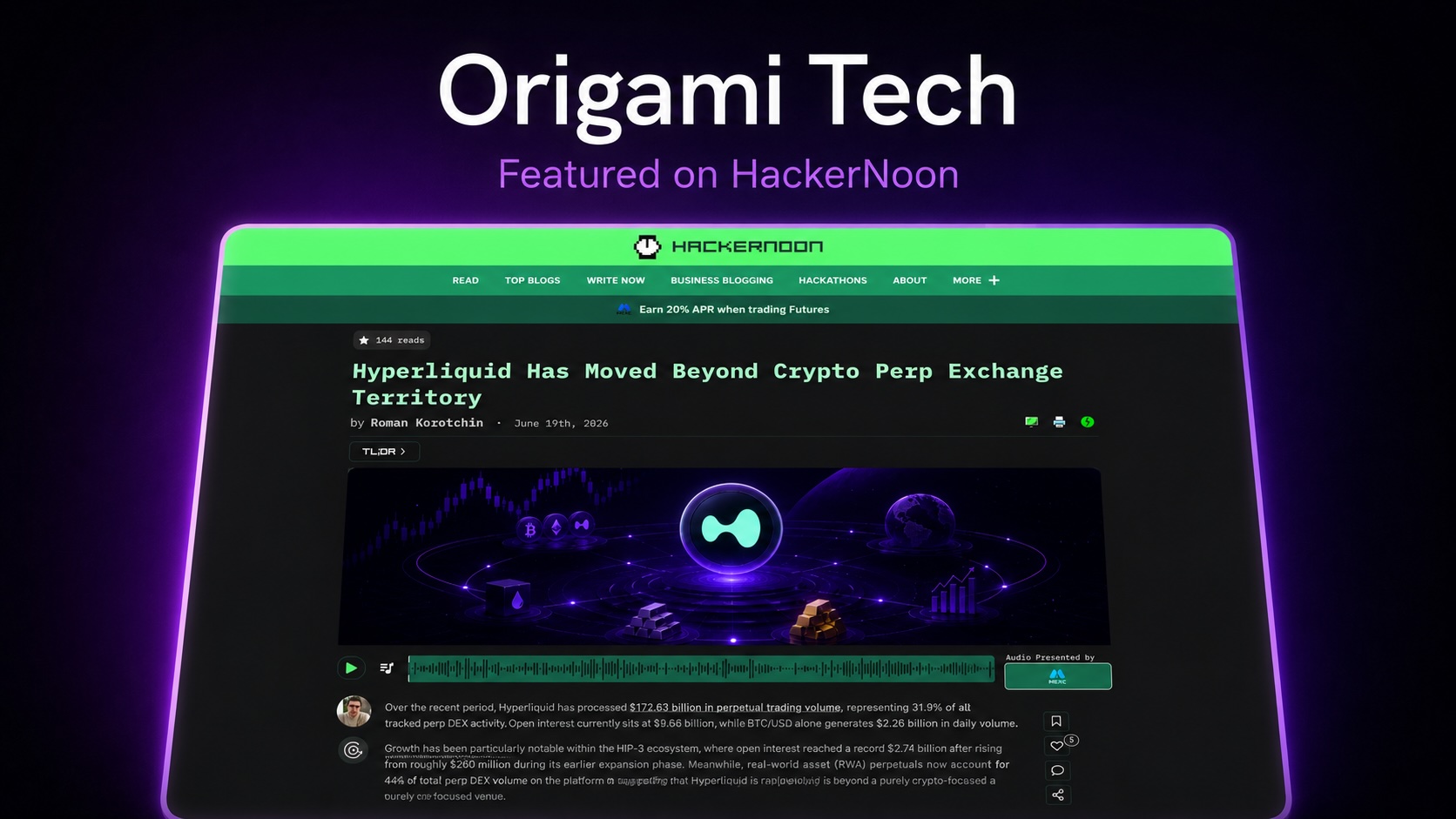
Origami Tech co-founder Roman Korotchin has published a new article on Hackernoon exploring how Hyperliquid is rapidly evolving beyond its origins as a purely crypto-focused decentralized exchange.
The article looks at the structural shifts within the platform, focusing on the rise of real-world asset (RWA) perpetuals, the impact of Portfolio Margin, and the changing dynamics of automated trading strategies.
Inside the piece:
• why Hyperliquid's asset mix now resembles a broader derivatives venue• how the HIP-3 framework drove a massive increase in open interest
• the capital efficiency benefits of the new Portfolio Margin system
• why traditional automation assumptions fail under hourly funding and L4 order book transparency
• how traders are recalibrating their strategies for this new environment
From Crypto Venue to Multi-Asset Market
For a long time, Hyperliquid was primarily associated with BTC, ETH, and HYPE. The dominant assumption was that it operated purely as a crypto-native venue competing directly with major centralized exchanges.
That assumption is shifting. The platform now supports 24/7 trading for assets like oil, silver, and equity index perpetuals. The liquidity for these instruments has deepened significantly. During certain peak periods, trading volume for WTI has even exceeded that of ETH. Gold and silver pairs are emerging as viable instruments for sophisticated strategies like grid trading and mean-reversion.
This transformation was largely driven by the HIP-3 framework, which empowers external participants to create and manage markets by staking HYPE tokens and defining risk parameters. This decentralized approach to market creation led to a rapid expansion, with open interest surging dramatically in a short period. The protocol enabled market expansion, and the participants actively engaged.
Portfolio Margin Changes the Capital Equation
A crucial structural development on Hyperliquid is the implementation of Portfolio Margin. This system transitions margining from a per-position model to a portfolio-level risk framework. Now, spot holdings, perpetual positions, and unrealized PnL are evaluated collectively in a single margin pool.
This has significant practical implications. Profits in one part of a trade can offset risk in another, thereby reducing liquidation exposure for hedged portfolios. A long spot position paired with a short perpetual is margined based on net exposure rather than gross position size. This structure makes carry trades and delta-neutral strategies inherently more capital-efficient on Hyperliquid compared to venues that isolate each position.
The system also integrates automatic yield on idle borrowable assets and maintains a unified risk engine across all HIP-3 markets, allowing capital to be deployed more effectively across a wider range of instruments.
Why Old Automation Assumptions No Longer Hold
The introduction of hourly funding, HIP-3 markets, Portfolio Margin, and L4 order book transparency means that trading strategies built for older iterations of Hyperliquid may no longer be reliable. The article highlights three primary areas where traditional assumptions fail:
•Funding rate cadence: Hyperliquid settles funding hourly, unlike the 8-hour cycle typical of centralized exchanges. For HIP-3 perpetuals, the platform utilizes a highly responsive premium formula. Strategies designed for slower funding cycles can experience significant drift, as the funding clock operates much faster.
•Liquidity has moved: While many automated strategies still focus on legacy assets like BTC and ETH, a stronger edge is emerging in RWA pairs. These pairs often feature lower competition, distinct volatility profiles, and funding dynamics that present new arbitrage opportunities.
•L4 order book transparency: Hyperliquid provides L4 order book depth, meaning individual orders are fully public. This transparency can be a liability for TWAP-style execution, as predictable order patterns can be identified and priced in by the market before a position is fully accumulated.
The Rebuild Is Already Underway
Traders who have been active on Hyperliquid are already adapting to these changes. Strategies that were effective on BTC and ETH are being rebuilt for HIP-3 pairs, with recalibrations for volatility bands, funding thresholds, and position sizing to account for the inclusion of commodities and equity indices.
While early results remain mixed, which is typical for a market still seeking equilibrium, the shift is clear. Hyperliquid’s competitive advantage now extends well beyond throughput and fees, driven by participants identifying opportunities and creating markets through the HIP-3 framework.
Read the full article "'Hyperliquid Has Moved Beyond Crypto Perp Exchange Territory"
HackerNoon is a global tech publication with millions of monthly readers and tens of thousands of contributing writers. It’s a go-to platform for technologists to share insights, publish stories, and explore the latest in tech and crypto.
You may also like

.jpeg)

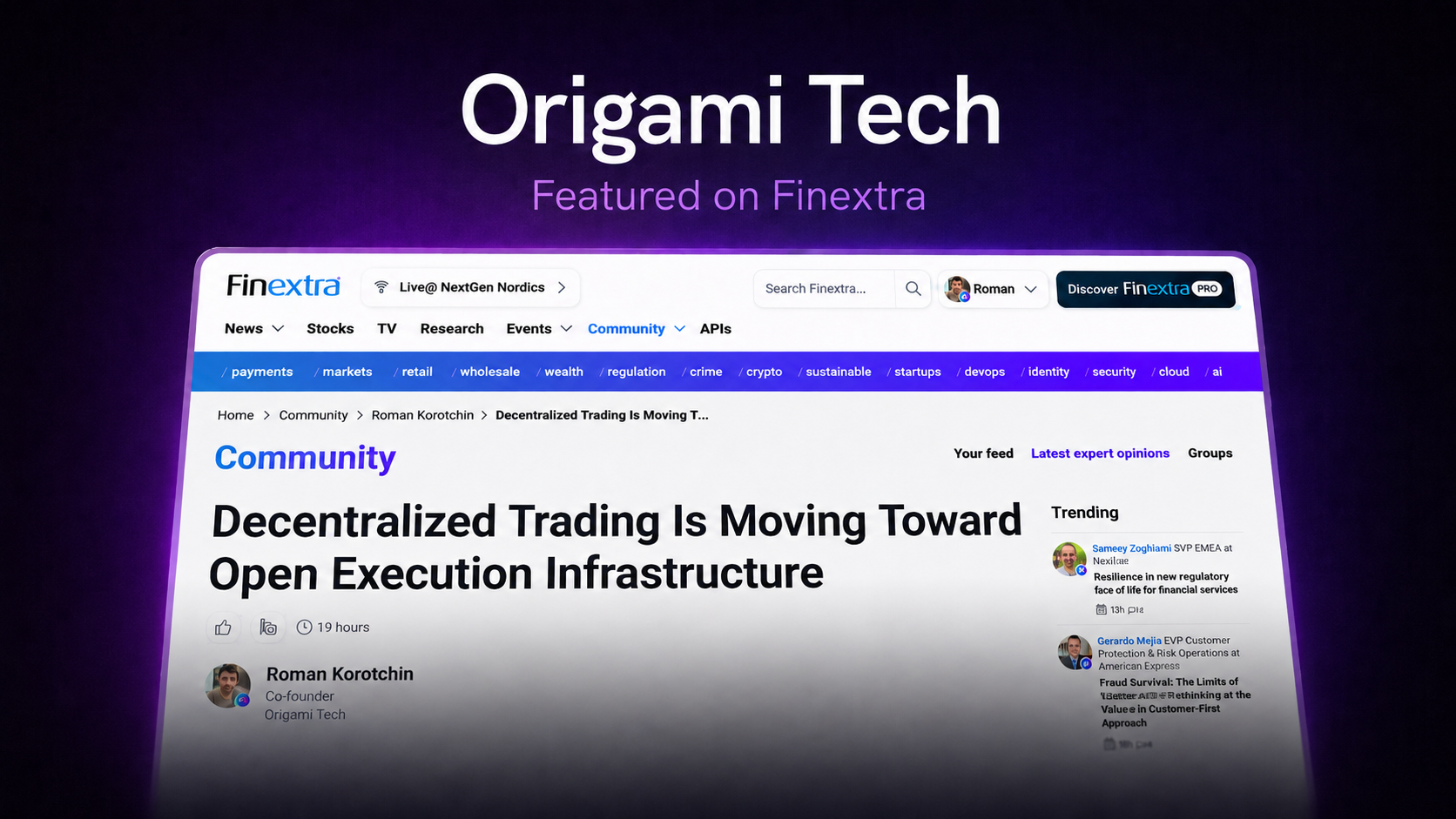
Origami Tech’s Roman Korotchin explores how decentralized trading is evolving into open execution infrastructure across liquidity, margin, and risk
Trade Smarter with Origami Tech
Take your crypto trading to the next level with our powerful automated trading terminal. Maximize profits, minimize risks, and stay ahead of the market 24/7.