
How Bitmaker Builds Market-Making Strategies With Origami Tech

Introduction
Origami Tech works with professional trading teams to show how automated strategies are configured and used in practice.
One example is Bitmaker, a market-making team that uses Origami Tech as an automation layer for building and running liquidity strategies across centralized and decentralized exchanges.
The collaboration brings together two different areas of expertise. Bitmaker contributes practical market-making logic, while Origami Tech provides the infrastructure used to turn that logic into executable bot parameters.
Through a series of public strategy breakdowns, Bitmaker has shown how decisions about spread, order-book depth, volume distribution, and refresh timing can be expressed inside Origami Tech.
The examples cover three basic market-making setups:
- a fixed spread grid;
- a 2% depth grid;
- a grid with increasing order size away from the spread.
Each configuration uses the same core building blocks — price formulas, order volume, buy and sell levels, and refresh intervals — but creates a different liquidity structure.
From Market-Making Logic to Bot Parameters
Market making is often described through outcomes such as tighter spreads, deeper order books, lower slippage, and more stable execution.
Behind those outcomes is a set of specific rules.
A market-making strategy must determine where orders are placed, how much volume each order contains, how many price levels the bot maintains, and how frequently those orders are refreshed.
Origami Tech turns these decisions into configurable formulas and bot settings.
The current market price is represented by ticker(). The position of each order inside the grid is represented by order_pos. Additional parameters determine order volume, the number of buy and sell orders, and the waiting period before the strategy refreshes.
This makes the execution logic visible.
Fixed Spread Grid: Keeping Liquidity Near the Market
Spread management is one of the central parts of Bitmaker’s market-making approach.
A fixed spread grid places buy and sell orders at predefined distances from the current market price. As the market changes, the bot periodically refreshes those orders.
The example configuration uses the following parameters:
{
"execute_price": "ticker() * (1 + order_pos * 0.0025)",
"execute_volume": "3 / execute_price",
"buy_orders_count": "2",
"sell_orders_count": "2",
"sleep_after_seconds": "180"
}
The execute_price formula places each order at a 0.25% interval from the current market price:
ticker() * (1 + order_pos * 0.0025)
The strategy creates two buy orders below the market and two sell orders above it. Each order has an approximate notional size of $3, while the full grid is refreshed every 180 seconds.
With a reference market price of 100, the example produces the following levels:
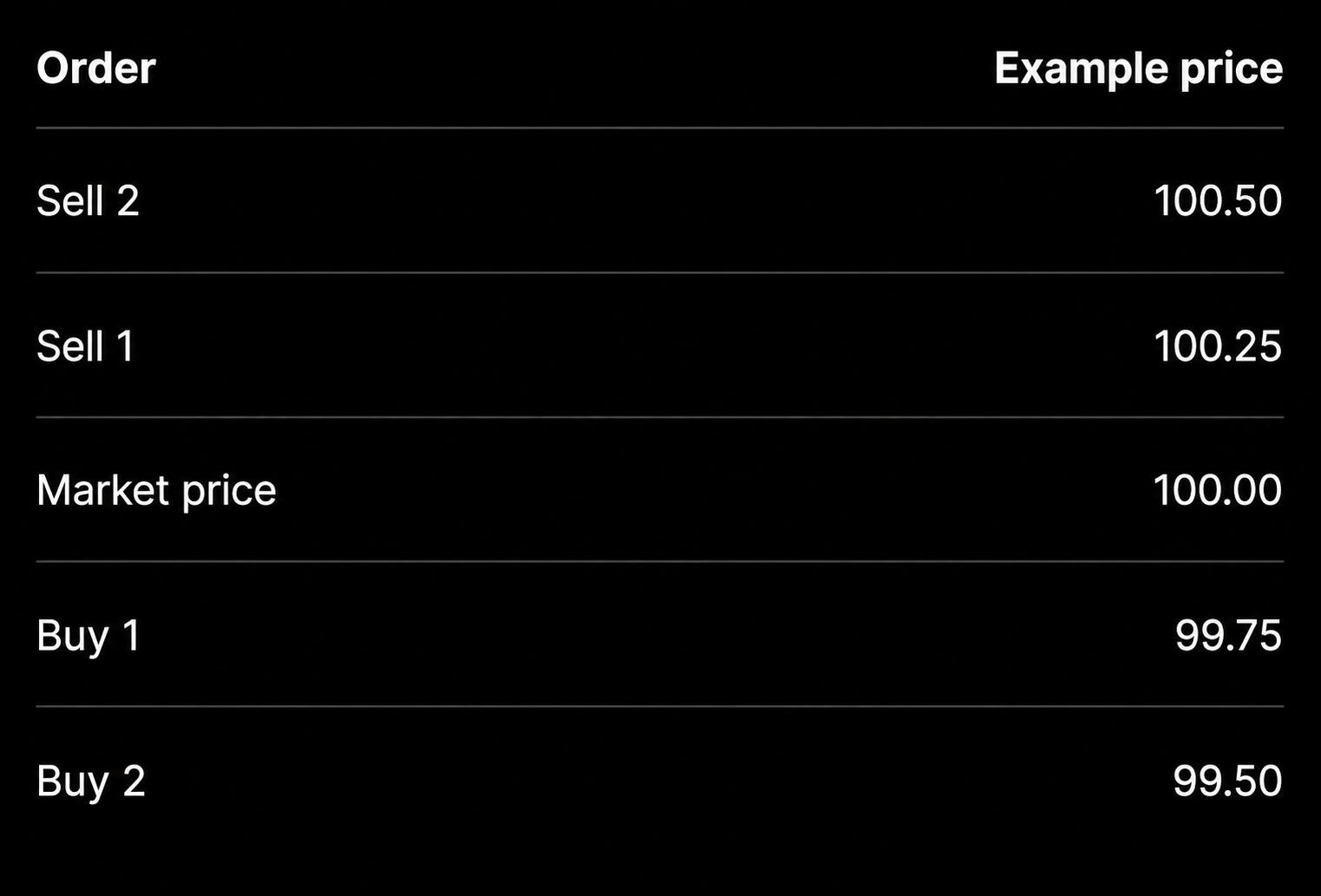
The nearest buy and sell orders form an estimated spread of approximately 0.5%.
This configuration keeps a limited amount of liquidity close to the current market price. It is a basic setup for maintaining orders on both sides of the book without distributing them across a wide price range.
The refresh interval also matters. Rather than leaving the original orders in place indefinitely, the bot checks the market and updates the grid every three minutes.
2% Depth Grid: Distributing Liquidity Across More Levels
Spread is only one part of market quality. Order book depth shows how much liquidity is available across different price levels and how effectively the market may absorb incoming trades.
A 2% depth grid extends liquidity farther above and below the current market price. Instead of concentrating only a few small orders near the spread, the strategy creates a larger set of levels across the book.
Bitmaker presented the following configuration:
{
"execute_price": "ticker() * (1 + order_pos * 0.004)",
"execute_volume": "150 / execute_price",
"buy_orders_count": "6",
"sell_orders_count": "6",
"sleep_after_seconds": "300"
}
The bot places six buy orders and six sell orders.
The price step between levels is 0.4%, and the six levels cover roughly 2% from the current market price on each side of the order book. Each order represents approximately $150, while the grid is checked and refreshed every five minutes.
Compared with the fixed spread example, this setup increases both the number of levels and the size of each order.
Its purpose is to create visible liquidity across a broader section of the book. By placing orders at several prices rather than concentrating all liquidity near the market, the strategy can support greater depth and smoother execution across a wider range.
The setup illustrates the difference between spread management and depth management.
A fixed spread grid focuses on maintaining nearby buy and sell orders. A depth grid distributes liquidity across more levels so the market has additional volume available as price moves farther from the center.
Increasing Order Size Away From the Spread
Liquidity does not have to be distributed evenly across every level.
In Bitmaker’s market-making logic, order volume can change depending on how far an order is placed from the current market price. Smaller orders near the spread can help control immediate exposure, while larger orders deeper in the book can provide additional market depth.
This behaviour can be configured in Origami Tech with the following grid:
{
"execute_price": "ticker() * (1 + order_pos * 0.003)",
"execute_volume": "(3 * abs(order_pos)) / execute_price",
"buy_orders_count": "4",
"sell_orders_count": "4",
"sleep_after_seconds": "120"
}
The bot places four buy orders and four sell orders, with a 0.3% step between levels.
The key difference is the volume formula:
(3 * abs(order_pos)) / execute_price
Order size is based on abs(order_pos), so the volume grows as the order moves farther from the current market price.
The approximate notional size by level is:
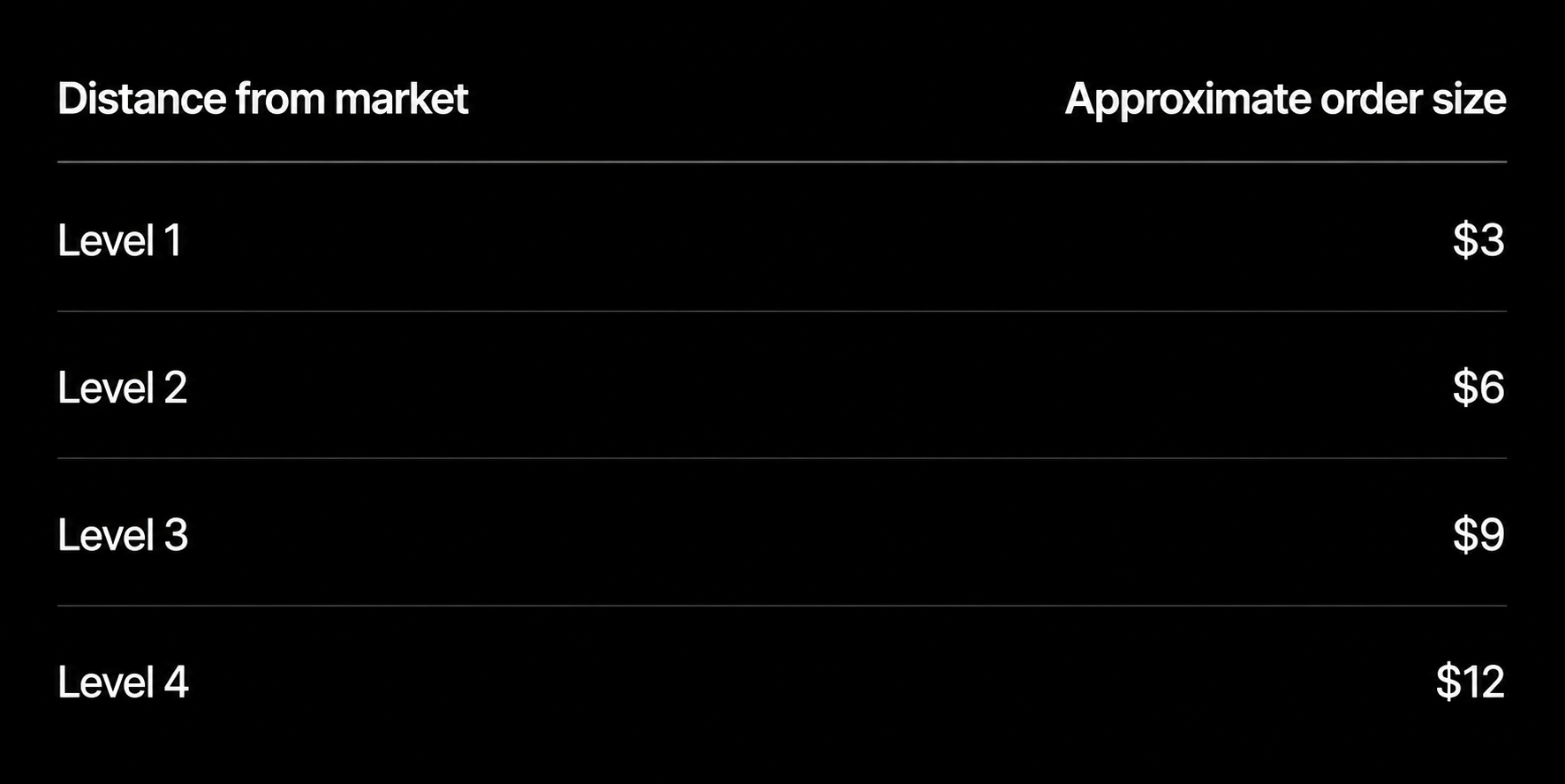
The grid refreshes every 120 seconds.
This creates a progressive liquidity structure. The orders closest to the spread remain smaller, while deeper levels carry more volume.
The configuration demonstrates that a market-making grid does not need to apply the same order size everywhere. Price placement and volume distribution can be controlled separately, allowing the strategy to shape liquidity according to distance from the market.
Three Configurations, Three Liquidity Objectives
The three examples use the same basic Origami Tech parameters, but they create different order book structures.
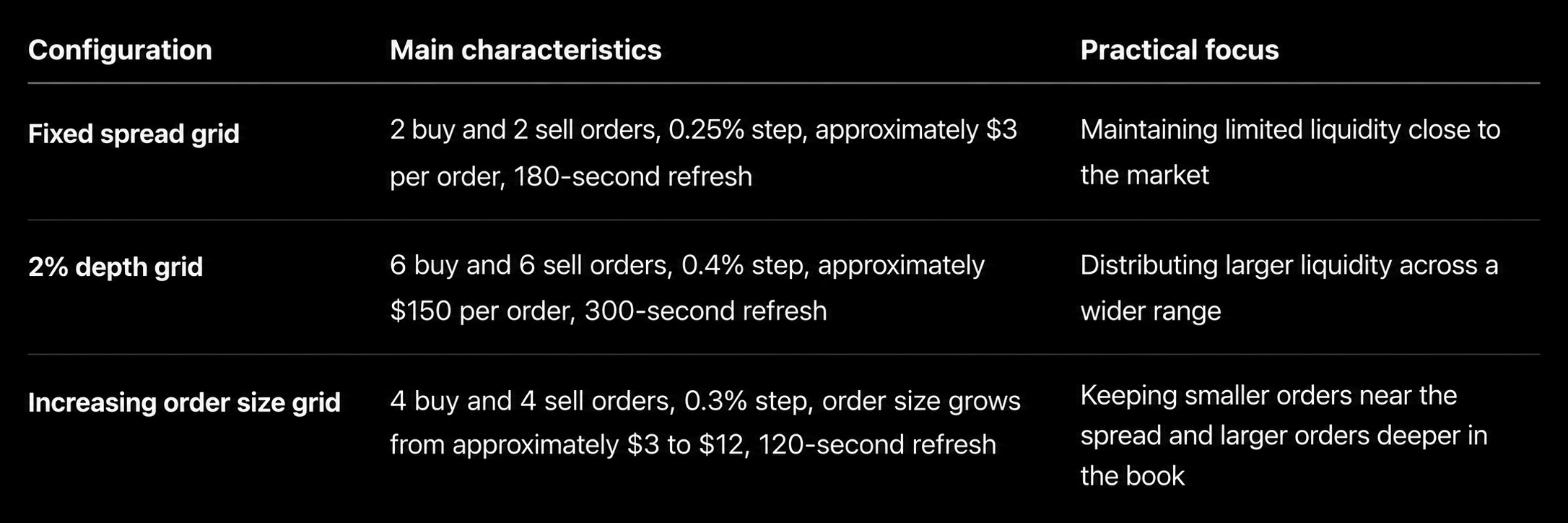
The differences are not limited to the number of orders.
Each strategy changes how capital is distributed, how quickly the grid reacts, and where liquidity is concentrated. A configuration designed to maintain a narrow nearby grid has different requirements from one intended to create visible depth across several levels.
The Role of Bitmaker and Origami Tech
Bitmaker contributes the market-making logic and practical view of liquidity execution.
Its configurations show how concepts such as spread, depth, order distribution, and refresh frequency can be translated into explicit trading rules.
Origami Tech provides the automation layer used to configure and run those rules. The platform allows parameters such as price formulas, order-volume formulas, buy and sell counts, and refresh intervals to be combined within a bot strategy.
The collaboration therefore connects two levels of market making.
Bitmaker explains what the liquidity structure is intended to achieve. Origami Tech provides the environment in which that structure can be expressed and automated.
Why Practical Configurations Matter
Market making is often discussed through broad performance indicators. A market may be described as liquid, stable, deep, or efficient, but those descriptions do not show how the underlying orders are created.
Practical configurations make the execution layer easier to understand.
They show that a market-making bot does not simply “provide liquidity.” It follows explicit rules governing price distance, order volume, grid size, and refresh timing.
Changing any of these parameters changes the resulting order book.
A smaller price step places levels closer together. More buy and sell orders extend the grid. A larger volume formula increases visible liquidity. A shorter refresh interval causes the strategy to check and update its orders more frequently.
By publishing real configurations, Bitmaker demonstrates how these decisions are implemented through Origami Tech rather than presenting market making only through its intended outcomes.
Conclusion
The collaboration between Bitmaker and Origami Tech provides a practical view of automated market making.
Bitmaker brings professional liquidity logic and explains how spread, depth, and order distribution work at the execution level. Origami Tech converts that logic into configurable bot parameters that define where orders are placed, how large they are, how many levels are created, and how frequently the grid is refreshed.
The three examples show that market-making strategies can use the same automation infrastructure while producing very different liquidity structures.
A fixed spread grid keeps small orders close to the market. A 2% depth grid distributes larger liquidity across more price levels. A progressive grid increases order size as distance from the spread grows.
Together, these configurations show how market-quality objectives become executable trading rules inside Origami Tech.
You may also like








Trade Smarter with Origami Tech
Take your crypto trading to the next level with our powerful automated trading terminal. Maximize profits, minimize risks, and stay ahead of the market 24/7.