
Roman Korotchin on Finextra: The Next Phase of Digital Asset Trading Automation

Introduction
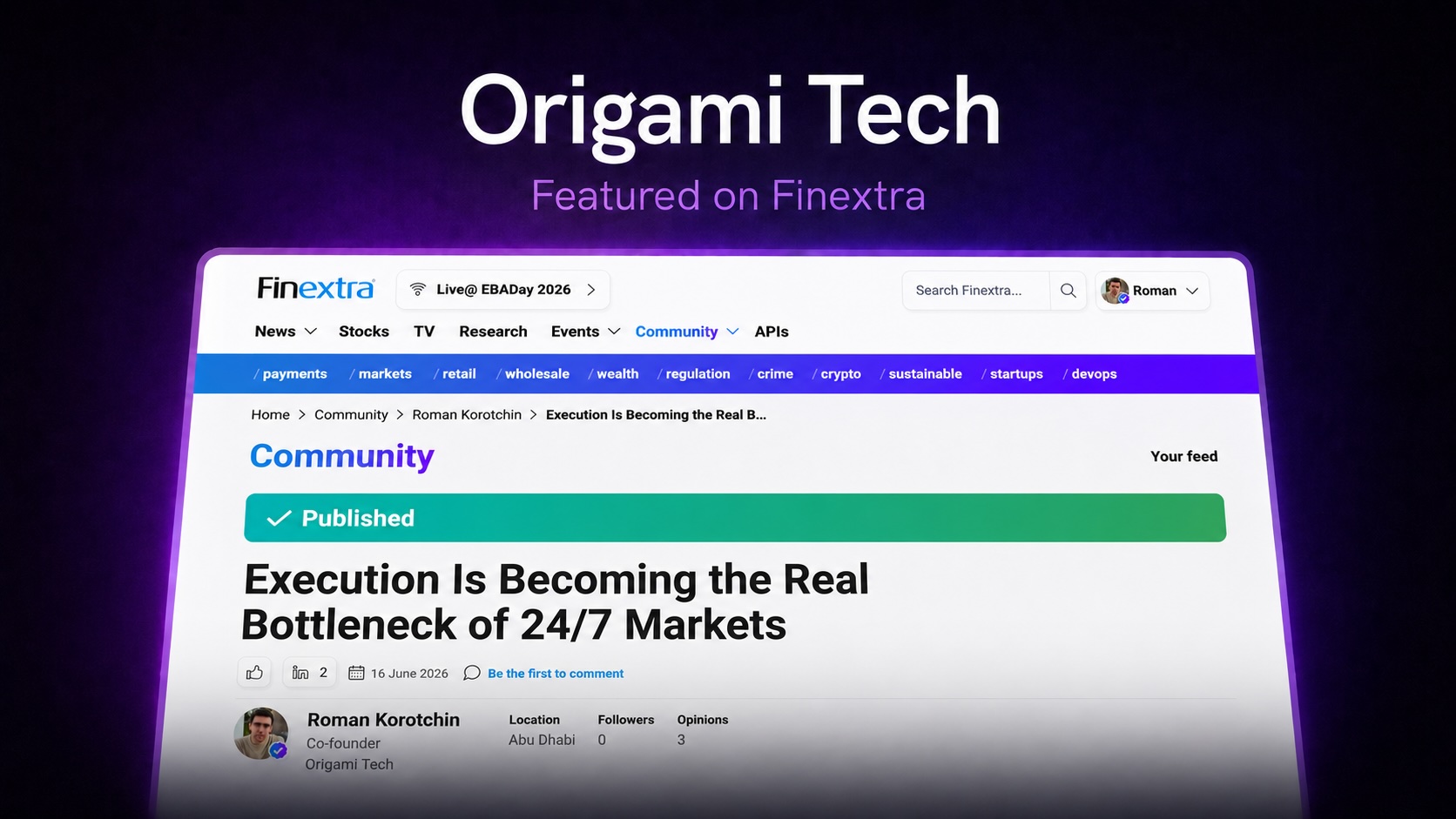
We’re pleased to present a new expert column by Roman Korotchin, co-founder of Origami Tech, published on the reputable financial platform Finextra. In this piece, he examines the industry’s transition toward integrated, automated digital-asset trading infrastructure and explains why multi-venue orchestration is becoming a cornerstone of the market’s next phase.
Read a section of the article "The Next Phase of Digital Asset Trading Automation" below;
By the end of 2025, institutional participation in digital assets has become a fact rather than a forecast. According to a joint survey by PwC and the Alternative Investment Management Association, 55 percent of hedge funds now hold crypto in their portfolios, up from 47 percent a year earlier. The average allocation stands near 7 percent of assets under management, with most funds maintaining a smaller exposure but remaining active in the market.
At the same time, decentralized exchanges have reached record volumes. In May 2025, total DEX trading volume climbed to about 474 billion dollars, representing roughly 25 percent of the global crypto spot market. Ethereum, Solana, and BNB Chain together account for nearly 87 percent of this activity. Derivatives on decentralized venues also continued to expand, reflecting the growing demand for transparent and automated on-chain execution.
A separate institutional survey by Coinbase and EY-Parthenon found that 83 percent of professional investors plan to further increase their crypto allocations in 2026. The data confirms that digital assets are now a strategic component of institutional portfolios rather than an experimental allocation.
The Mid-Market Gap
Trading technology remains polarized. Institutional OEMS and EMS platforms are powerful but expensive, often requiring custodial setups and complex integrations. Retail bots, while accessible, are limited to single-venue strategies and lack the transparency and flexibility needed for professional execution.
Between these extremes lies a growing mid-market segment. Active traders, smaller funds, and professional individuals managing more than 500 thousand dollars now require institutional-grade precision with lower operational barriers. The rise of DEX derivatives, cross-exchange liquidity, and the shift toward transparent, auditable automation make this need increasingly urgent.
Economics of Automation
The global market for institutional trading technology is valued at around 7 billion dollars in 2025 and could reach 10 billion by 2033, expanding at an average annual rate of about 11 percent. Within this landscape, the crypto execution and automation segment is growing faster than any other category. Analysts estimate its size at 1.7 billion dollars in 2025, with a trajectory toward 6.5 billion by the early 2030s, driven by the normalization of automation for digital-asset strategies.
A notable shift in business models is already visible. Instead of relying on licenses or subscriptions, modern trading infrastructure increasingly monetizes through traded volume. Liquidity becomes the revenue driver, creating alignment between platforms, traders, and liquidity providers.
Read the full article
Finextra is a leading global platform for fintech professionals, providing trusted news, research and insights across banking, payments, capital markets and wealth. With a community of more than 40,000 senior leaders and innovators, it helps industry experts stay informed about new technologies, regulations and developments while connecting with peers online and at events.
You may also like



.jpeg)
Trade Smarter with Origami Tech
Take your crypto trading to the next level with our powerful automated trading terminal. Maximize profits, minimize risks, and stay ahead of the market 24/7.