
An Interview with Roman Korotchin, CEO of Origami Tech

Introduction
Today we’re sharing an interview with Roman Korotchin, Co-Founder and CEO of Origami Tech. During the discussion, Roman explains how the platform was built, what problems it aims to solve for traders, and how Origami Tech supports automated trading workflows across centralized and decentralized venues.
Q: Roman, could you explain what Origami Tech is today and how the project originally started?
— Origami Tech is a trading platform where users can create and automate trading strategies, including quite complex algorithmic setups with low latency.
We did not start by building Origami Tech as a product for external users. Before that, we were focused on market making. We had been doing it for several years, and during that time we built a lot of internal infrastructure. The team behind it is fairly large, around thirty people, and many of them are developers.
At some point, I realized that I was spending too much time thinking about connectivity, execution, and exchange-specific details instead of strategy logic. I kept asking the team to build new algorithms so I could test ideas directly in production. Eventually, they came back with a low-code internal solution that allowed me to focus only on trading logic. That was the foundation.
Q: When did you decide that this infrastructure could be useful for other traders as well?
— About a year or a year and a half ago. We reached a point where the system was stable enough and flexible enough to be shared.
We decided to open it to users so they could launch automated strategies without dealing with technical overhead. The idea was simple: users think about strategies, and we handle everything else, including connections to centralized and decentralized venues, execution, statistics, and user experience.
Q: There are many trading terminals and automation platforms on the market. What do you see as the main difference between Origami Tech and those tools?
— The real difference is that we do not offer a limited set of predefined bots. We give users the ability to build their own trading logic. That includes complex algorithms, multiple conditions, and data from different venues.
For example, you can use RSI as a signal for entering a trade, but that can be just one part of the logic. You can also include balance data from other venues or use external indicators. Recently, I shared an example where I recreated an automated pair trading strategy based on asset correlation and price deviation thresholds. It took me around two hours to implement it, which shows how flexible the system is.
Q: How critical is low latency for these kinds of strategies?
— It is critical. That comes directly from our market making background.
The backend is optimized in terms of colocation, WebSocket connections, and data processing. Users do not need to think about these things at all. They work with strategy logic that feels simple, almost like Excel-style code, while execution happens on an optimized infrastructure.
Q: Which trading venues are currently supported on Origami Tech?
— We support both decentralized and centralized venues. On the decentralized side, we work with venues like Pacifica, Hyperliquid, Aster, Lighter, Extended and others that offer fast execution and efficient markets.
On the centralized side, we support all major exchanges, plus several additional ones. Some venues are used internally for market making only and are not exposed to users yet. That is usually because they are too small or do not offer proper API access for retail traders.
The platform supports both spot and futures markets. We originally started with spot trading and expanded later.
Q: Many platforms today are focused on point farming or very narrow strategies. What can users actually build on Origami Tech?
Users can write trading strategies directly on the platform. In practice, this is code that allows, for example, opening positions around local price minima or maxima.
It is also possible to build strategies that are fully focused on positive PnL. We already see several such approaches performing well in real trading. Hedging logic can be implemented on the same venue using another instrument or across different venues using the same instrument. All of this can be set up without excessive complexity.
Origami Tech does not sell a single predefined bot designed purely for point farming, although the platform can be used that way if needed. For instance, a user can build a market making strategy that places quotes around the mid price and refreshes them every second or even on every tick.
After running a strategy, users can move to the advanced statistics section, see that a particular setup does not perform well in terms of PnL, and switch to a more effective strategy.
As mentioned earlier, users can unify multiple accounts under a single entity that we call a project. Within a project, a strategy can use public data from one account and private data from another to operate across them.
This makes it possible to implement hedging strategies, DCA setups, and market making across different markets. It is also possible to automate funding rate arbitrage. From a user experience perspective, this may not always look simple, but technically it works reliably.
Currently, the most difficult task for us is making the user experience as simple as possible. The solution itself is complex, and finding the right balance between powerful functionality and accessibility for end users is always challenging.
Q: How do you handle more complex setups involving multiple accounts?
— We use a concept called a Project. Within a project, users can unify multiple accounts. A strategy can use public data from one account and private data from another. This makes it possible to run hedging strategies, DCA strategies, market making strategies across different venues and even automate funding rate arbitrage.
From a UX point of view, this can look complex, but technically it works reliably.
Q: What are users actually using the most right now?
Currently, the most popular features on Origami Tech are trading presets. These are ready-made strategy templates that show what types of bots can be run on the platform. Internally, they are still low-code strategies, but users can connect them to their accounts and start trading quickly.
For perpetual futures with one-way margin mode, there are two main types of presets. The first is a DCA-based strategy that opens a position, averages into it as price moves away from break-even, and closes it with a small profit once price returns closer to that level. This approach is widely used because it is relatively simple and works across different market conditions.
The second type is a range-based strategy that focuses on identifying local price minima and maxima to open and close long or short positions. Depending on market behavior, this can generate either small or more substantial positive PnL.
On centralized exchanges that operate in hedge mode, the most commonly used preset is again DCA, but with internal hedging on the same instrument.
Q: Origami Tech also works with trading and liquidity competitions. How does that fit into the platform?
— In addition to presets, we regularly run trading competitions together with blockchain and crypto projects. These competitions are designed to attract user attention to specific markets. In practice, this approach works quite well. Projects allocate budgets for such initiatives, and we bring users who trade on those markets using automated strategies.
What is important here is that users retain full control over their strategy settings. They can choose how they want to trade. Some focus on providing liquidity; others place directional orders or trade short-term price movements. The platform does not force a specific behavior.
Rewards in these competitions are usually distributed based on trading volume. The more a user trades, the higher the reward. At the same time, we use self-trade prevention flags on the exchange side to ensure that users generate non-toxic flow for the projects involved.
Alongside volume-based competitions, we also run liquidity-focused programs. In this case, the reward structure is closer to farming, but the goal is very specific.
For example, if a project has insufficient liquidity within a certain price range, such as plus or minus two percent around the mid price on a decentralized order book, it can make sense to incentivize users to provide liquidity exactly in that range.
In short, we help projects attract liquidity in a controlled way. At the end of a competition period, users receive rewards from the project based on their actual contribution to order book depth.
Q: What are the main priorities for Origami Tech right now?
— We are still actively refining the product from a user experience perspective. The system itself is complex, so one of our main priorities is making it easier to work with without reducing flexibility. For the near term, rather than looking five years ahead, we have a very dense roadmap for the coming year.
A major focus is creating simpler ways for users to work with trading bots. We are developing what we call simple bots, which do not require complex local setup. One of the first examples is an arbitrage bot.
We also have ongoing work around spot arbitrage. This is an area we have been actively working in for several years, and we plan to make fully automated arbitrage tools available to users. These tools are designed to scan for opportunities automatically and can operate both on spot markets and across multiple accounts.
In parallel, we are expanding our API offering. We have accumulated a large amount of data on the backend, and there is demand from institutional users who want to run our trading bots directly from their internal systems.
Another important part of the roadmap is a proper backtesting system. We are deliberately avoiding a superficial solution that looks good but provides misleading results. Instead, we are working toward a backtester that uses our own data and correctly accounts for fees, slippage, and real execution conditions, even if that takes more time to build.
Q: How do you see Origami Tech evolving over the next few years?
— We want to continue supporting both centralized and decentralized venues, but over time our interest in decentralized exchanges has grown stronger.
Decentralized futures markets are developing quickly, yet the trading infrastructure around them is still relatively immature. Many of the same challenges we addressed on centralized venues exist there as well, often in a more fragmented form. Supporting decentralized venues in a structured way is becoming an increasingly important direction for us.
Beyond infrastructure, education and community development play a major role in how we think about long-term growth. As users go from launching strategies with a few clicks to working with more complex setups, questions naturally arise. Being available to explain how the platform works and how strategies behave is an important part of what we do.
From our perspective, technical and business considerations are always closely connected. If users can focus on strategy rather than technical limitations, and feel comfortable asking questions as complexity increases, then Origami Tech is evolving in the right direction.
You may also like
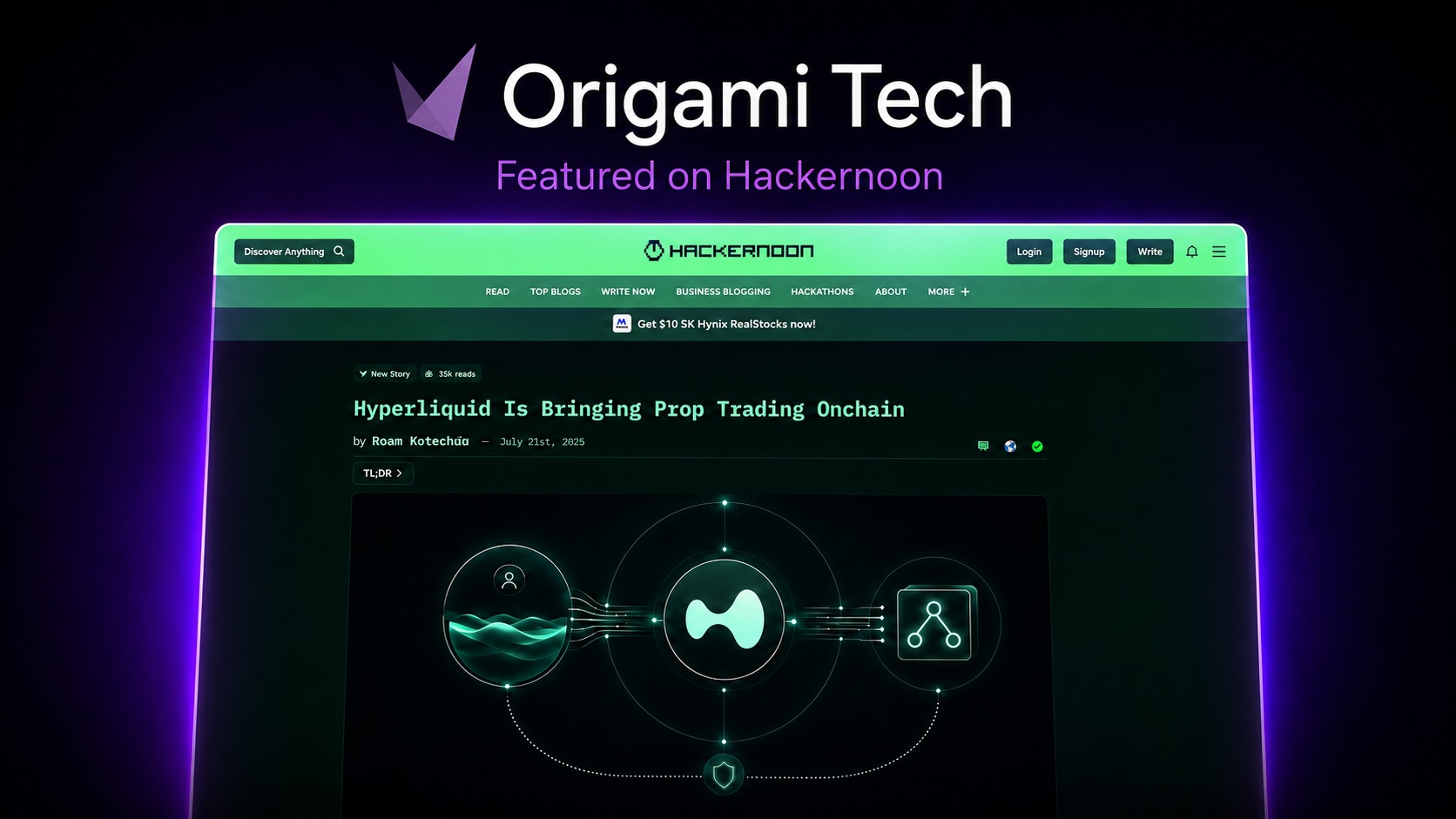

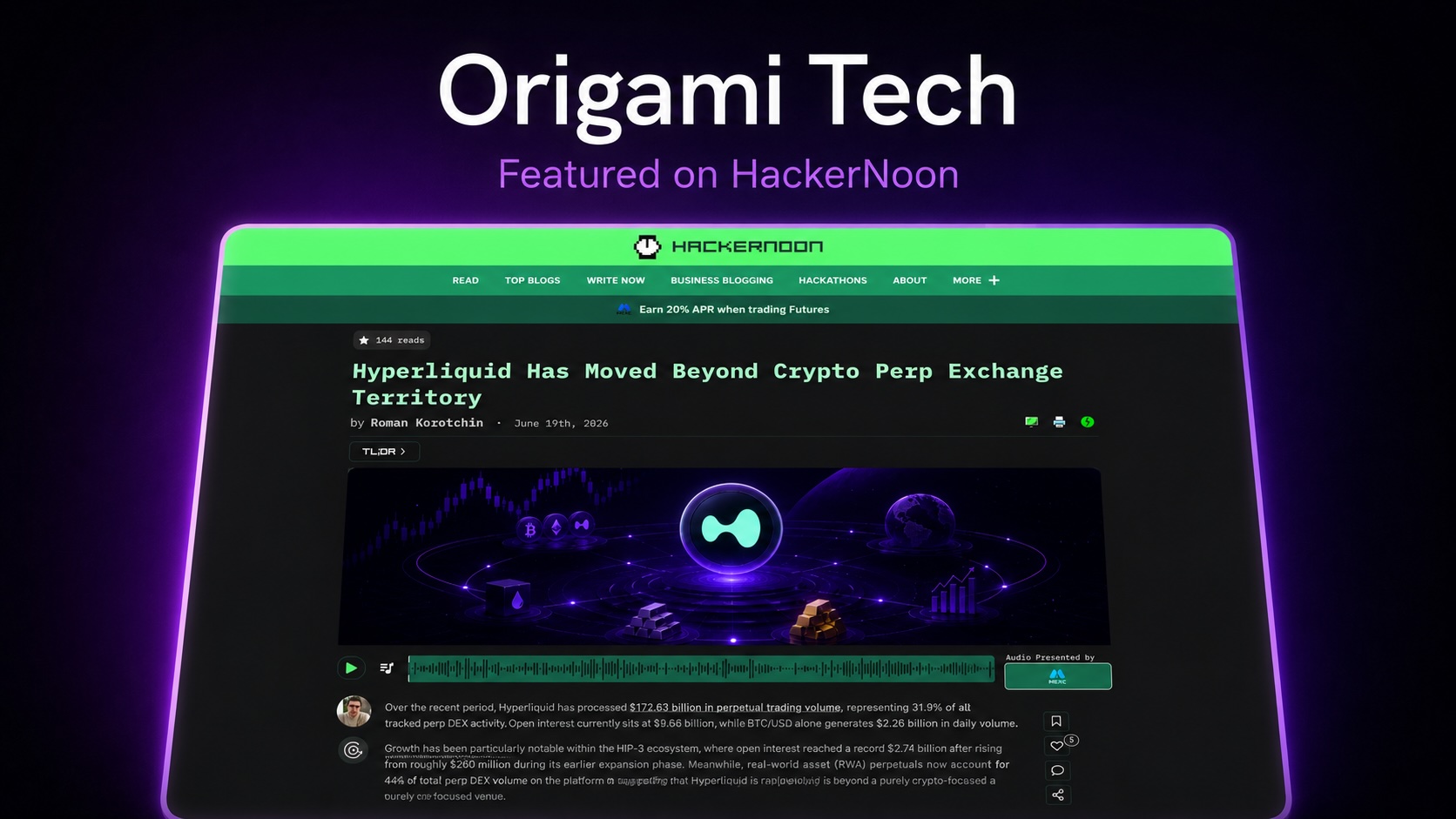

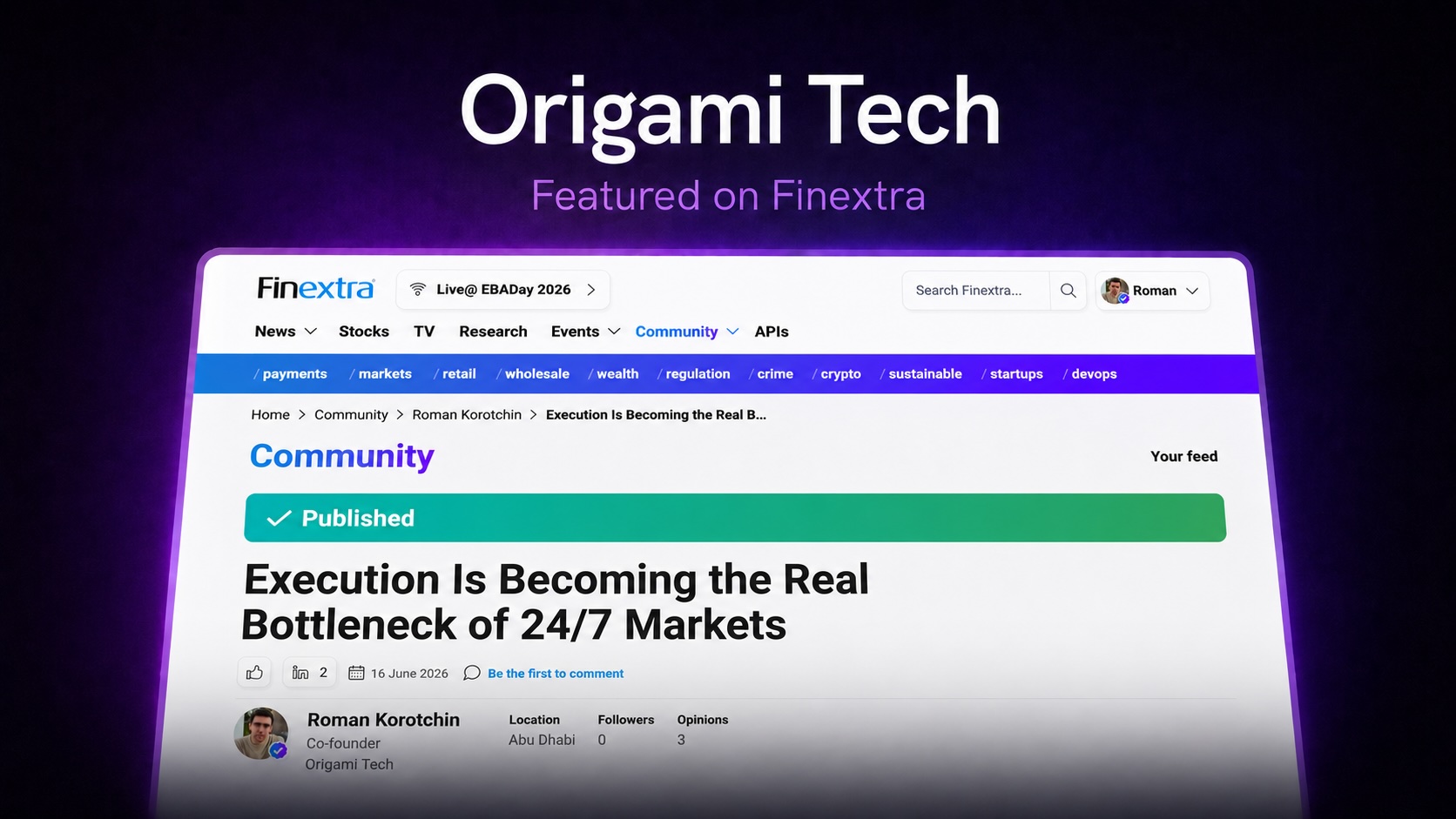

Discover Roman Korotchin’s expert insights on Finextra as he explores the rise of automated, multi-venue digital-asset trading and its impact on market evolution
.jpeg)

Trade Smarter with Origami Tech
Take your crypto trading to the next level with our powerful automated trading terminal. Maximize profits, minimize risks, and stay ahead of the market 24/7.