
Which Performs Better: Static vs. Dynamic Volume Allocation in Crypto Bots?
Introduction
When setting up an automated crypto trading bot, deciding how much of your capital you want to use per trade will directly affect performance, drawdown, liquidity exposure, and even the probability of hitting exchange-imposed limits.
Two primary approaches dominate this space: static volume allocation and dynamic volume allocation. Both are widely used in crypto bot trading. But which of them has the better upside? The answer, as always in trading, is nuanced and depends on strategy design, market conditions, and the goals of the trader.
Let’s explore both methods in detail, compare their strengths and weaknesses, and assess how they perform when applied to different crypto trading bot strategies.
Static Volume Allocation: Simplicity at a Cost
Static volume allocation involves a trading bot placing orders with a fixed size regardless of balance fluctuations or market conditions. For example, a crypto bot operating with ths strategy might always execute trades worth 100 USDT or 0.01 BTC.
This approach is straightforward, deterministic, and easy to debug. It's often the default configuration when launching a bot using prebuilt strategy presets. Because volume remains unchanged across trades, it's simple to model potential outcomes, which makes it attractive for testing and educational purposes.
However, static allocation carries inherent limitations:
- Lack of Adaptability: Markets are dynamic. When volatility spikes or liquidity dries up, static order sizes may either become too risky or too small to capture opportunities.
- Capital Inefficiency: Bots might underutilize your available balance during profitable periods, or overextend it during downturns.
- Poor Risk Scaling: If your portfolio grows or shrinks significantly, fixed trade sizes lose relevance, leading to disproportionate risk.
For these reasons, static allocation works best in highly stable environments or when the bot operates within a tightly controlled portfolio segment (e.g., a fixed-size sub-account on an exchange.
Dynamic Volume Allocation: Precision with Complexity
Dynamic volume allocation adjusts trade sizes based on current variables, including account balance, asset price, and volatility measures. In a crypto trading bot app, this is done using formulas and real-time functions.
For example, a bot might allocate 5% of the available balance per trade:
execute_volume = balance('counter').available * 0.05 / execute_price
This formula ensures that as account value grows, so does the trade size and vice versa.
Dynamic allocation offers multiple advantages:
- Risk Scaling: Exposure adjusts with capital. A shrinking balance leads to smaller trades, helping to mitigate losses.
- Improved Capital Efficiency: Bots deploy a higher percentage of available funds during bullish cycles, maximizing opportunity capture.
- Adaptability: When combined with volatility or liquidity indicators, bots can size trades to market conditions, going smaller in erratic moves and larger in trending environments.
Yet, this flexibility comes at a cost:
- Greater Complexity: Dynamic formulas require thoughtful construction, especially when multiple variables interact.
- Execution Risk: Poorly designed formulas might lead to unpredictable trade sizes, overexposure, or unexpected API errors.
- Difficult Debugging: Since volume is calculated in real-time, backtracking a mistake requires deeper log analysis.
Despite these challenges, dynamic allocation is considered the best practice for most production-level crypto trading bots, especially those participating in high-volume environments like Origami Tech’s trading competitions.
Strategy Context: When to Use Static vs. Dynamic
To evaluate which approach performs better, it’s important to examine use cases:
1. Grid Bots and Scalping Strategies
Grid bots thrive on high trade frequency. In these setups, static allocation is often preferred to prevent runaway exposure due to fast market moves.
However, Origami Tech allows for hybrid approaches, such as setting a max trade cap, but dynamically adjusting within bounds:
execute_volume = min(balance('counter').available * 0.02, 75)
This maintains the simplicity of caps with the intelligence of balance sensitivity.
2. Trend-Following or RSI-Based Bots
Strategies based on technical indicators (e.g., RSI, EMA) benefit from dynamic sizing. If a bot detects a high-confidence signal, it can allocate more capital. This aligns well with risk-reward ratios and portfolio performance over time.
With Origami Tech’s formula engine, traders can even create logic like:
execute_volume = 100 if rsi < 30 else 50
In this setup, the bot reacts not just to your balance but also to market sentiment, enabling more precise trading.
For a more detailed overview of indicators, check out our article: Top 5 Technical Indicators Every Crypto Trading Bot Should Use.
3. Volume-Based Competitions
When participating in volume-based trading competitions hosted by Origami Tech, the goal shifts from profitability to generating the highest trade volume.
Here, dynamic allocation becomes an optimization tool. Bots can increase order count using micro-trades while respecting exchange minimums:
execute_volume = max(balance('counter').available * 0.01, symbol().total_counter_min)
This approach increases trade frequency without breaching rules, leveraging Origami’s execution engine for better throughput.
Comparative Metrics: Static vs. Dynamic in Practice
Here’s how both methods compare across critical performance dimensions:
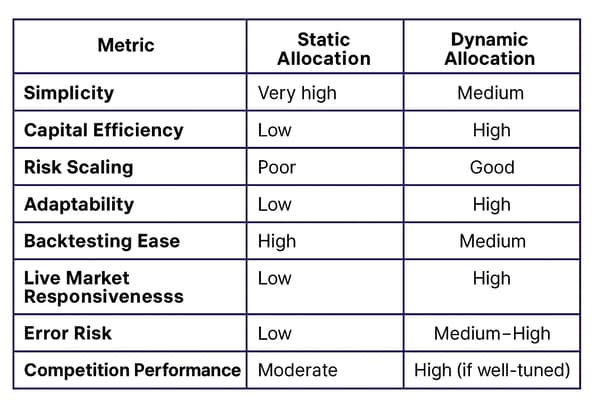
Static allocation is a great choice when prototyping, pursuing risk-limited strategies, or when managing very small balances. Dynamic allocation, on the other hand, is great for adaptive strategies, live environments, and scenarios demanding optimal resource usage.
Best Practices When Using Dynamic Volume Allocation
To avoid common pitfalls, here are some recommendations tailored for Origami Tech users:
- Use Lower Bound Limits
Protect against over-aggressive sizing when the account is flush with funds.
execute_volume = min(balance('counter').available * 0.1, 250) - Respect Exchange Minimums
Exchanges often have minimum volume rules. Use - symbol().total_counter_min to comply:
execute_volume = max(
balance('counter').available * 0.05,
symbol().total_counter_min
)
- Separate Trade and Balance Logic
Avoid embedding too many formulas into a single grid. Use user-defined variables for clarity. - Test with Origami Tech’s Research Button
Before launching a live bot, use the Research tool to simulate execution and verify dynamic logic. - Enable Logging and Monitor Closely
Real-time dashboards in Origami Tech allow users to track execution metrics per bot. Use this to observe how volume adapts across different market cycles.
So, Static or Dynamic Volume Allocation: Which Is Better for Crypto Bots
In isolation, neither static nor dynamic volume allocation is inherently “better.” The answer depends entirely on:
- Your strategy type (grid, swing, trend-following)
- Market conditions (volatile vs. ranging)
- Bot objectives (volume vs. PnL vs. risk control)
- Your available capital (small portfolios may perform well with fixed sizing)
That said, dynamic allocation offers greater performance potential in most scenarios, especially when combined with formulaic conditions, balance checks, and Origami Tech’s automation logic.
For advanced traders, dynamic allocation is the preferred standard. It makes better use of balances, offers improved scaling, and supports real-time adaptation. Static allocation still has a role, especially during strategy validation or educational use, but it becomes increasingly restrictive as one moves toward serious trading and competitions.
Building Smarter Bots with Origami Tech
Origami Tech was built to give traders the tools to control every part of their automation, from the smallest formula tweak to full strategy orchestration across exchanges. With its formula interpreter, integrated indicators, and real-time dashboards, it becomes easy to compare static and dynamic strategies side by side.
Whether you're building the best crypto trading bot for portfolio growth or deploying the best free crypto trading bot to participate in a competition, understanding volume allocation is key. Treat volume not as a fixed number, but as a dynamic variable that responds to market forces, and your bots will behave more like intelligent agents than simple scripts.
Ready to take control of your trading automation?
Start experimenting with dynamic allocation on Origami Tech and build crypto bots that trade smarter, not just harder.
FAQ
What’s the difference between static and dynamic volume allocation in a crypto trading bot?
Static allocation uses a fixed trade size for every order, while dynamic volume changes based on factors like balance or price. Dynamic methods are more flexible and often used in the best automated crypto trading bots for live market conditions.
Which volume allocation method works best for crypto trading competitions?
Dynamic allocation typically performs better in competitions, as it helps automated crypto trading bots generate consistent volume while managing risk. It also adapts to changing balances and liquidity, which is crucial in high-frequency environments.
Can I use technical indicators with dynamic volume in my trading bot crypto setup?
Yes, Origami Tech lets you combine dynamic volume formulas with indicators like RSI or EMA. This makes your crypto bot trading strategy more responsive to real market signals.
Is static volume better for beginners using a crypto trading bot app?
Static allocation is easier to set up and ideal for testing or learning. Many users start with static settings when launching their first crypto trading bot.
How do I prevent my dynamic volume formula from overtrading or undertrading?
Use limits like the min() and max() functions in your formulas to set caps and floors for execute_volume. This helps your auto trading bot crypto strategy stay within safe boundaries while adapting to market changes.
You may also like





Trade Smarter with Origami Tech
Take your crypto trading to the next level with our powerful automated trading terminal. Maximize profits, minimize risks, and stay ahead of the market 24/7.